Florida Outdoor Living Upgrades That Add the Most Home Value in 2026
Deprecated: Case statements followed by a semicolon (;) are deprecated, use a colon (:) instead in phar:///Users/artyom.dovgopol/Documents/sites/askdoss.com/wp/vendor/react/promise/src/functions.php on line 369
Deprecated: Constant E_STRICT is deprecated since 8.4, the error level was removed in phar:///Users/artyom.dovgopol/Documents/sites/askdoss.com/wp/vendor/wp-cli/wp-cli/php/WP_CLI/Runner.php(1334) : eval()’d code on line 2
Deprecated: Case statements followed by a semicolon (;) are deprecated, use a colon (:) instead in phar:///Users/artyom.dovgopol/Documents/sites/askdoss.com/wp/vendor/react/promise/src/functions.php on line 369
Deprecated: Constant E_STRICT is deprecated since 8.4, the error level was removed in phar:///Users/artyom.dovgopol/Documents/sites/askdoss.com/wp/vendor/wp-cli/wp-cli/php/WP_CLI/Runner.php(1334) : eval()’d code on line 2
Florida Backyards Sell Houses. Here’s Where to Put Your Money
Ask any agent working the Fort Myers–Naples corridor what buyers look at first, and the answer is almost never the kitchen. It’s the lanai. The pool cage. The view through the sliding doors to whatever’s waiting outside. In a state where you can grill in January and eat dinner on the patio in November, outdoor space isn’t a perk — it’s the product.
And the data reflects this. The Zonda 2024 Cost vs. Value Report found that nine of the top ten home improvement projects with the highest ROI are exterior upgrades. NAR’s Remodeling Impact Report on outdoor features puts the homeowner joy score at 9.7 out of 10 — the highest of any remodeling category — and notes that 92% of Realtors recommend improving outdoor areas before listing. In Florida, where screen enclosure installation is practically a rite of homeownership, the returns are even more pronounced. A mid-size pool cage that costs $15,000–$23,000 to build can add $25,000–$27,000 to an appraisal, per Florida contractor and appraiser estimates.
Below are seven outdoor projects ranked by what they actually return in this market — with real cost ranges, permit gotchas, and the mistakes that tank your ROI.
Pool Screen Enclosures — The One Upgrade Florida Buyers Expect
Every agent in Southwest Florida has the same story: buyer walks into a house with an unscreened pool, mentally subtracts $15K–$20K from their offer, and moves on. A pool without a cage in Lee or Collier County isn’t charming — it’s a maintenance headache and an insurance conversation. Before budgeting for outdoor upgrades, understand the ongoing pool maintenance costs you will be responsible for. Screened pools keep out debris, mosquitoes, and the occasional iguana, while reducing UV exposure on the pool deck and cutting chlorine evaporation.
The Florida Building Code (8th Edition, 2023) requires screen enclosures to meet Section 2002.4 wind load ratings — 110 mph design pressure with all panels in place, plus a 300-pound vertical load test per linear foot of framing. That’s not optional. Any installer who skips engineered drawings, concrete footers, or a Lee County permit is handing you a liability, not an upgrade. Removable panels must carry a decal stating they “shall be removed when wind speeds exceed 75 mph.”
Real cost picture for 2026: screen enclosures run $6–$15 per square foot for materials, or $15–$25 per square foot fully installed with permitting, concrete footers, and super gutters. A small cage (roughly 20×30 feet) lands at $12,000–$15,000. A mid-size enclosure for a standard residential pool (around 30×50 feet) runs $15,000–$23,000. Full custom builds on larger homes push past $30,000.
Material choice drives both cost and longevity. Standard 18×14 fiberglass mesh is the default — affordable, decent visibility, 5–7 year lifespan before Florida sun degrades it. Phifer’s 20×20 mesh improves airflow but tears easier. PetScreen (polyester-vinyl coated) survives dogs and cats without shredding. No-see-um MicroMesh blocks the tiny biting midges that make coastal evenings miserable from Sanibel to Siesta Key, but cuts airflow by about 20% and costs 40–60% more than standard mesh.
Lanai Enclosures — Square Footage Without the Addition Price Tag
The lanai is Florida’s version of an extra room that doesn’t technically count as living space — but buyers absolutely count it. A covered patio with screening becomes a year-round dining area, a home office with a view, or a playroom that doesn’t need AC. Appraisers won’t include it in your heated square footage, but they’ll note it as a comparable adjustment, and it will show up in listing photos doing more work than any bathroom renovation.
Screened lanai enclosures run $3,000–$12,000 depending on size and roof structure. The jump to glass or acrylic panel systems (essentially a three-season room) pushes into $15,000–$30,000 territory but opens up a different conversation: now you’re climate-controlled, and that changes the appraisal math entirely. In upscale markets like Naples or Lakewood Ranch, glass lanai enclosures have become a top-three selling feature according to local agents.
One thing people miss: if you already have a homeowners insurance policy that covers your lanai as part of the structure, upgrading from screen to glass may require a policy adjustment. Glass panels rated for impact (Miami-Dade NOA-approved) cost more upfront but can actually reduce your insurance premium in high-wind zones.
Outdoor Kitchens — The Upgrade That Photographs Better Than Everything Else
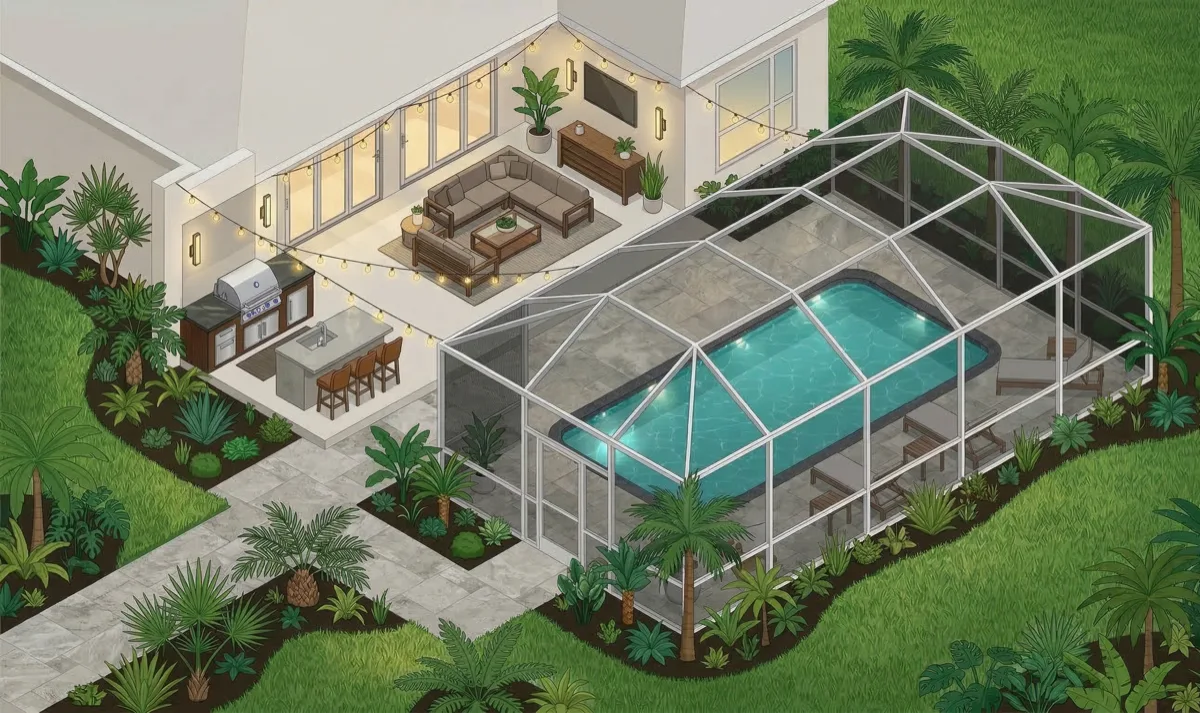
Here’s what a listing agent will tell you: outdoor kitchens don’t just add value, they stop the scroll. In a market where buyers are swiping through 40 listings on their phone, a photo of a granite-topped grill island with bar seating makes them pause. That attention is worth money.
The ROI on outdoor kitchens runs wide — industry data shows 55% to 200% recovery depending on market and execution. The high end of that range belongs to warm-climate states like Florida, California, and Texas, where outdoor cooking isn’t seasonal. The low end is what you get when you overbuild for the neighborhood or use materials that can’t handle Florida humidity.
Budget tiers that work in this market: a built-in grill island with countertop and storage runs $10,000–$15,000 and punches above its weight in the $350K–$500K home range. A mid-range setup with refrigerator, sink, and seating goes $20,000–$40,000. Above that, you’re in custom stonework and full appliance suites — powerful for luxury listings, but wasted on a starter home in Cape Coral. Match the upgrade to your comp set, not to your Pinterest board.
Material note: HDPE (high-density polyethylene) cabinets are becoming the standard over wood or stainless in Florida outdoor kitchens. They’re waterproof, UV-stabilized, and won’t swell in the humidity. Traditional wood cabinetry in an outdoor kitchen looks great in October and warps by July.
Pergolas and Shade Structures — Making the Yard Usable After 10 AM
Florida summers produce an honest problem: your beautiful outdoor space is unusable from mid-morning through late afternoon, five months a year. Pergolas and shade structures fix this. And unlike a screen enclosure, a well-placed pergola also frames the view — it gives the eye a boundary, which makes any outdoor area feel more like a room and less like a slab of concrete next to the lawn.
A standard aluminum or pressure-treated wood pergola runs $3,000–$8,000 installed. Motorized louvered roof systems — the ones that open flat for airflow and tilt closed when the afternoon rain hits — are the fastest-growing category in Florida outdoor living right now. They cost $15,000–$35,000 depending on span, but they’ve replaced fixed pergolas in most new high-end builds across Sarasota and Manatee counties.
The ROI on a pergola alone is modest — 50–65%. But that number is misleading, because pergolas are force multipliers. A $20,000 outdoor kitchen under a $10,000 pergola looks like a $50,000 setup in listing photos. The return on the combined project outperforms either item alone.
Landscaping and Hardscaping — The 30-Second Value Judgment
Buyers decide how they feel about a house within 30 seconds of pulling into the driveway. NAR data backs this — 97% of Realtors say curb appeal is important for attracting buyers, with 75% calling it “very important.” The Zonda Cost vs. Value Report puts exterior projects at the top of every ROI list, year after year. Garage door replacement leads nationally at 194% return. Landscaping doesn’t hit those numbers, but it doesn’t need to — it changes the speed of the sale, and in Florida, speed matters because carrying costs eat equity fast.
Professional landscaping packages for a typical Florida lot range from $5,000 to $20,000. Go native: coontie, muhly grass, sabal palms, and green buttonwood are adapted to the soil and the water restrictions that hit every summer. They grow in, not out — meaning less maintenance and lower irrigation bills, which is exactly what the buyer behind you will calculate when they see the beds. Pair that with paver walkways, low-voltage LED path lighting, and a clean mulch edge, and you’ve changed the first impression without a single structural change.
If you’re selling and want to understand how landscaping plays into your closing cost calculations, it’s good to know: strong curb appeal correlates with shorter time on market, and every week you shave off saves you mortgage payments, insurance premiums, and the gradual price reductions that signal desperation to buyers.
Patio Extensions and Paver Upgrades — Cheap Square Footage
Extending a patio with pavers is one of the simplest upgrades on this list and one of the most underused. A 200-square-foot paver extension costs $2,400–$5,000. That’s roughly the price of a mediocre bathroom refresh — except the patio shows up in listing photos and the bathroom doesn’t (unless it’s a full gut).
In Florida, pavers beat poured concrete for practical reasons: they flex with soil movement instead of cracking, drain through the joints during afternoon downpours, and can be individually replaced if one takes a hit. Stamped concrete is cheaper ($10–$18 per square foot vs. $12–$25 for pavers) but it cracks and can’t be spot-repaired.
ROI sits at 45–60%. Not the highest on this list, but the entry price is low enough that the risk is minimal. If you’re doing a screen enclosure or outdoor kitchen anyway, extending the patio under or around it is a high-use add-on.
Outdoor Lighting — The Cheapest Way to Double the Perceived Value of Everything Else
This is the one upgrade that contractors consistently say people skip and consistently regret skipping. A $15,000 pool cage looks like a $15,000 pool cage during the day. At night with well-placed lighting — uplights on the palms, LED strips along the screen frame, warm sconces on the lanai — it looks like a resort feature. The delta between lit and unlit outdoor spaces is enormous in buyer perception, and it costs almost nothing relative to the other projects on this list.
Professional outdoor lighting systems run $2,000–$6,000, all LED, with smart controls for scheduling and dimming. Expect 40–55% direct ROI — but the real return is in how it amplifies everything around it. Lighting is the seasoning, not the steak. Budget for it alongside your main upgrade, not as an afterthought.
Florida Outdoor Upgrades: Cost vs. ROI Comparison
| Upgrade | Typical Cost | Est. ROI | Best For |
|---|---|---|---|
| Pool Screen Enclosure | $12,000–$23,000 | 70–100%+ | Homes with unscreened pools |
| Lanai Enclosure | $3,000–$30,000 | 60–75% | Covered patios, sunroom conversion |
| Outdoor Kitchen | $10,000–$40,000 | 55–200% | $350K–$500K+ listings |
| Pergola / Shade | $3,000–$35,000 | 50–65% | Best as a combo with kitchen |
| Landscaping | $5,000–$20,000 | 50–60% | Every home, especially pre-listing |
| Patio Extension | $2,400–$5,000 | 45–60% | Low-cost add-on to bigger projects |
| Outdoor Lighting | $2,000–$6,000 | 40–55% | Amplifies all other upgrades |
Estimated ROI by Upgrade Type
Picking the Right Upgrades for Your Budget
Under $10,000: Landscaping plus outdoor lighting. Highest visual impact per dollar. Both projects are finished in days, not weeks, and they make every future upgrade look better. This is the move if you’re listing in the next 60–90 days and need fast results.
$10,000–$25,000: Pool screen enclosure or lanai enclosure. If your home has an unscreened pool, this is the single highest-ROI project available to you. If the pool is already caged, go lanai. Both add functional square footage that buyers immediately value.
$25,000–$50,000: Screen enclosure plus outdoor kitchen. This combination repositions your listing. You’re not selling a house with a patio anymore — you’re selling an outdoor living space, which is a different product at a different price point.
$50,000+: The full build: enclosure, kitchen, pergola, landscaping, lighting. At this level you’re competing with new construction on the lifestyle front, and that’s a powerful position in Florida’s resale market.
One rule trumps all of this: don’t out-improve the neighborhood. Check your comps on AI property search tools before committing capital. If the median sale on your street is $350K, a $60K outdoor kitchen is money you won’t see again.
When to Build and When to Sell
Florida’s buying season peaks January through April — snowbirds, relocators, and early retirees hit the market hard. If you’re planning to sell in that window, get outdoor work done by November at the latest. You need settled landscaping, clean photos, and a listing that shows the space in use, not under construction.
The dry season (November through May) is also the best building window. Screen enclosure installations go faster without daily 3 PM thunderstorms delaying curing and cleanup. Contractors are slightly less booked in early winter, which sometimes translates to faster scheduling — though don’t expect discounts. Labor is tight across all trades in Southwest Florida.
If you’re not selling soon but want to understand where the market is heading, take a look at our best cities to buy analysis and the home renovation ROI guide — both will help you think about which improvements make sense for your timeline.
The Math Is Simple
Outdoor upgrades in Florida aren’t discretionary — they’re the frontline of your home’s value. The buyers walking through your door in Fort Myers, Naples, Sarasota, or Tampa are judging the outdoor space with the same scrutiny they give the kitchen. A screened pool enclosure, a shaded outdoor kitchen, or even just clean landscaping with good lighting can separate a listing that sits from one that gets multiple offers in week one.
The projects with the strongest return — screen enclosures, lanai builds, landscaping — all do the same thing: they make the home feel larger and more livable without the cost of adding heated square footage. In a state where people use their outdoor space 10 months out of 12, that’s where the use is.
Frequently Asked Questions
How much does a pool screen enclosure cost in Florida in 2026?
A pool screen enclosure in Florida costs $15–$25 per square foot fully installed, including permitting and concrete footers. A small enclosure (20×30 ft) runs $12,000–$15,000, a mid-size cage (30×50 ft) averages $15,000–$23,000, and custom builds on larger properties can exceed $30,000. Material type (fiberglass, PetScreen, MicroMesh) and local wind load requirements under FBC Section 2002.4 are the biggest cost variables.
Do screen enclosures increase home value in Florida?
Yes. Florida appraisers commonly assign $25,000–$27,000 in added value to homes with screened in-ground pools. While a screen enclosure isn’t counted as heated square footage, it’s treated as a comparable adjustment in appraisals and is considered a baseline expectation by buyers in most Southwest Florida markets, including Fort Myers, Cape Coral, and Naples.
What outdoor upgrade has the highest ROI for Florida homes?
Pool screen enclosures consistently deliver the strongest return for Florida homeowners, often recouping most or all of the installation cost at resale. Landscaping and curb appeal improvements also rank high — 92% of Realtors recommend improving outdoor areas before listing, and the Zonda 2024 Cost vs. Value Report shows that nine of the top ten home improvement projects by ROI are exterior upgrades.
Is an outdoor kitchen worth it in Florida?
In Florida’s climate, outdoor kitchens return 55% to 200% of their cost depending on scope and neighborhood. The sweet spot is $10,000–$20,000 for a built-in grill island with storage and seating — enough to photograph well and attract buyers without over-improving the property. Warm-climate states like Florida see significantly higher returns on outdoor kitchens than the national average.
When is the best time to build a screen enclosure in Florida?
The dry season — November through May — is the ideal construction window. Daily afternoon thunderstorms during summer delay work, and contractors are slightly less booked in early winter. If you’re building to sell, complete outdoor upgrades by November to have listing-ready photos before the January-through-April peak buying season when northern buyers flood the Florida market.